
STEM education
Learning that works with your hands.
STEM — Science, Technology, Engineering and Mathematics — is a way of learning that connects four subjects to help students understand how the world works and solve real problems.
Why it matters
Not just passing exams — building, inventing, leading.
From smartphones to medical breakthroughs, STEM shapes modern life. Research shows that over 75% of the fastest-growing careers are in STEM-related fields.
- Critical thinking
- Creativity & innovation
- Problem-solving
- Confidence through doing
- Readiness for future careers
- Teamwork
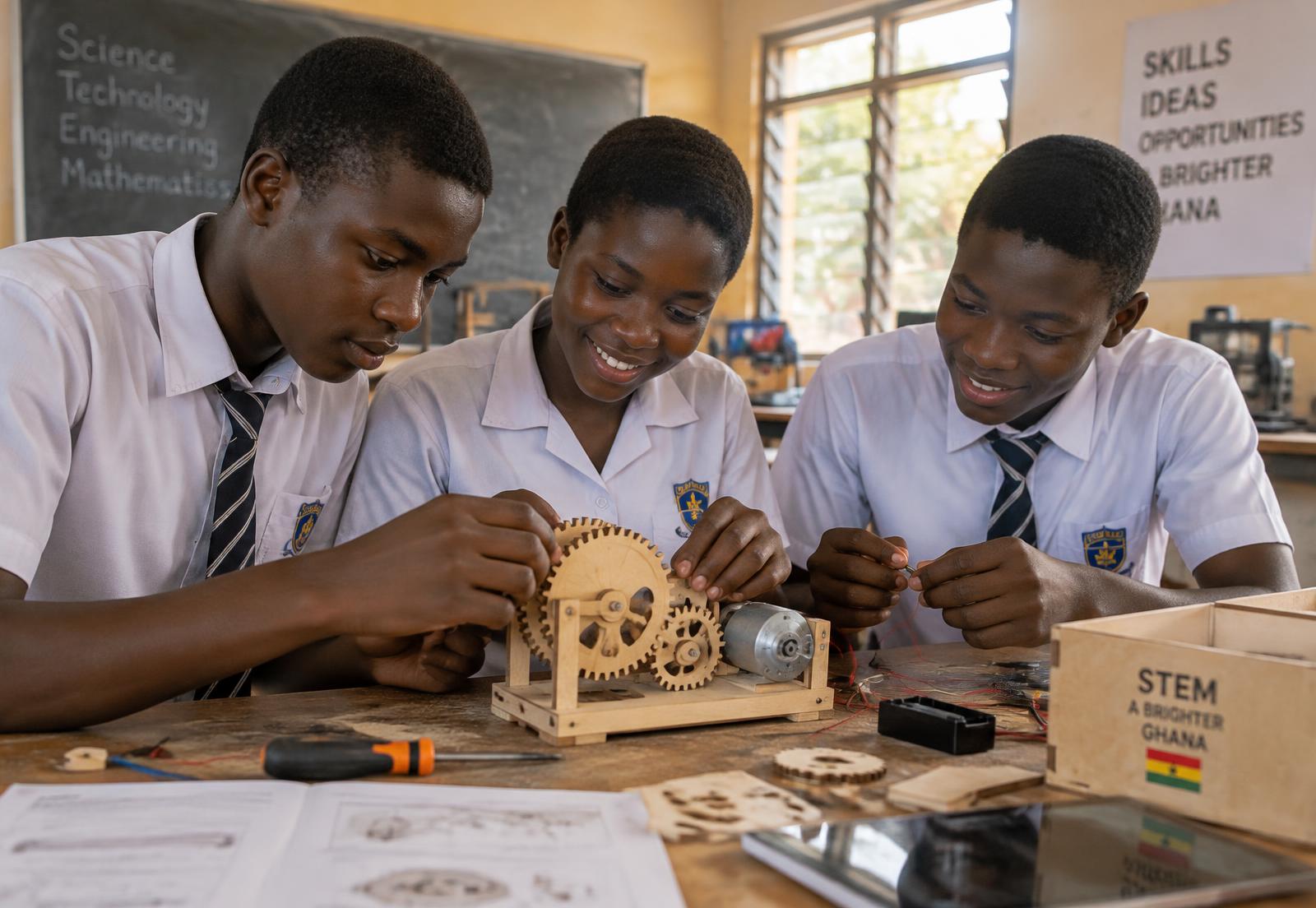
The four pillars
What each letter stands for.
S
Science
Understanding the natural world through observation and experiment.
Biology · Chemistry · Physics
T
Technology
Using tools, systems and devices to solve problems.
Computers & software · Robotics · Artificial intelligence
E
Engineering
Designing and building solutions to real-world problems.
Bridges & machines · Robots · Sustainable systems
M
Mathematics
The foundation of logic, patterns and problem-solving.
Algebra · Geometry · Statistics
STEM in Ghana
Too many students learn science only from the board.
Across Africa, including Ghana, access to practical STEM tools is limited. Without hands-on experience, students miss out on technical skills and the confidence to innovate. Hands-on kits let them apply theory, build real projects and learn through trial and error — and active learning has been shown to improve knowledge retention dramatically compared to passive study.
Our commitment
- High-quality STEM kits
- Support for schools & teachers
- Hands-on, project-based learning
- Inspiring the next generation